•Why President doesn’t want records released, by Omokri
By Mandy Park
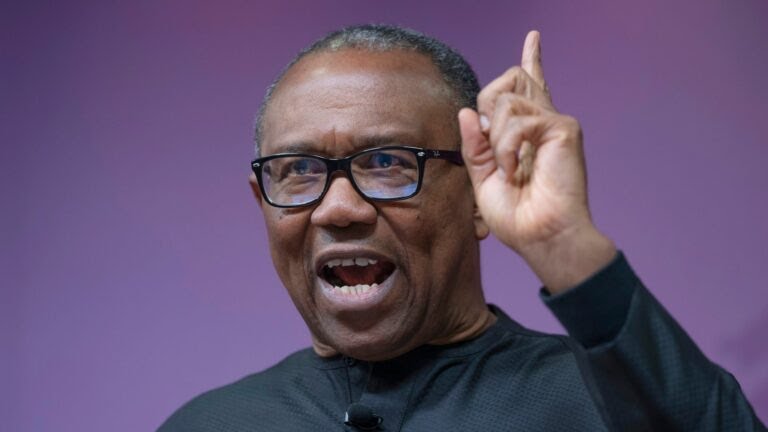
Presidential candidate, Peter Obi, has criticised President Bola Tinubu’s reported request for a United States (U.S.) court to restrict the release of records held by American law enforcement agencies in connection with historical investigations allegedly linking him to drug trafficking.
Meanwhile, United States-based policy advisory and lobbying firm Von Batten-Montague-York is afraid that if Tinubu attends the United Nations General Assembly (UNGA) meeting this month, he may be embarrassed.
However, the ambassador-designate of Nigeria to Mexico, Honduras, Guatemala and Nicaragua, Reno Omokri, said Tinubu was challenging the release of records held by U.S. law enforcement agencies because they might contain private, non-criminal information that he would not want made available to his political opponents.
Obi described the pushback from Tinubu and his agents as embarrassing, arguing that a sitting President should be willing to confront questions surrounding his past.
His reaction followed a 16-page court filing in which lawyers representing Tinubu reportedly asked a U.S. court to block the release of records held by the U.S. Department of Justice (DOJ), Federal Bureau of Investigation (FBI) and Drug Enforcement Administration (DEA).
Tinubu’s lawyers had argued in the filing that releasing the records could violate the President’s privacy rights.
“Leadership, in my humble view, demands the courage and humility to confront one’s history to acknowledge mistakes, provide candid explanations where questions arise, and, where necessary, apologise and seek forgiveness. True authority is strengthened, not diminished, when a leader accepts responsibility rather than seeks to shield uncomfortable aspects of the past from legitimate scrutiny.”
The former Anambra State governor’s comments come amid renewed public interest in records relating to Tinubu following legal proceedings in the U.S.
IN a post on its verified X handle yesterday, the U.S. firm also said the meeting Tinubu had been pushing for with U.S. President Donald Trump at the UNGA would not happen.
According to the firm, key members of the Trump administration have made it clear that the POTUS was not going to meet privately with an alleged heroin trafficker.
It, however, said that as President of Nigeria, Tinubu could travel to New York for the UNGA under the access and transit protections afforded to representatives of UN member states.
“We look forward to Tinubu attending the UNGA next month. Unfortunately, he is going to be embarrassed. From reports we have seen, from South Africa to Italy, world leaders attending the UNGA will be fully aware of the heroin-trafficking allegations against Tinubu.
“If we are authorised, we will put into operation our plan to ensure every New Yorker within a six-mile radius of UN Headquarters learns about Tinubu’s alleged role in smuggling poison (heroin) onto American soil,” the firm said.
Von Batten-Montague-York, L.C also challenged claims that Tinubu was never criminally investigated by the FBI in connection with heroin trafficking, saying it had obtained a large volume of records from the FBI and was reviewing and redacting portions of the documents where necessary
It said: “The FBI states under oath that the court has already determined that a criminal investigation of Nigerian President Bola Tinubu (@officialABAT) was officially acknowledged.
“Let that sink in: This is a sworn declaration submitted by the FBI to a U.S. federal court stating that Nigerian President Bola #Tinubu was criminally investigated in connection with the trafficking of #heroin.”
It further cited the FBI’s explanation for withholding some of the records under law-enforcement exemptions.
The firm quoted the FBI as stating that “the responsive records herein were compiled in furtherance of the FBI’s investigation of multiple individuals for drug trafficking crimes.”
Reno Omokri, in defence of his principal, said the FBI could have records bearing Tinubu’s name without those documents amounting to criminal records.
The ambassador-designate made the argument in a post on X yesterday while responding to reports surrounding the ongoing legal battle over the release of the records.
He disputed reports suggesting that the FBI had released Tinubu’s “criminal records” to a U.S. judge, describing the characterisation as misleading.
According to him, FBI databases contain extensive non-criminal information on U.S. citizens, residents and foreign nationals. He said such records could be generated through routine background checks, including screenings conducted for people applying for U.S. visas.
The records held by the FBI, Omokri added, could contain biometric, biographical and financial information, arguing that the “existence of such records does not establish criminal conduct.”
Some of the requested records have been linked to allegations surrounding a 1993 civil forfeiture proceeding involving approximately $460,000. Tinubu has denied wrongdoing in connection with the allegations.
The legal dispute intensified after the FBI indicated that it had records responsive to Greenspan’s FOIA request. The bureau then asked the court for permission to submit some of the materials privately, arguing that releasing all the records could expose law-enforcement techniques and potentially endanger individuals.
A U.S. judge subsequently allowed the FBI to submit sensitive materials for private judicial review, meaning the court could examine the documents without making them public at that stage.